

last updated:
April 21, 2026
min read
Cortisol belly fat: What’s true, what’s not, and what to do next



Got stress? You might be wondering if it’s causing weight gain in your abdominal area—or giving you so-called stress belly. While true that stress plays a role in midsection weight gain, it’s a lot more complicated than what wellness influencers make it out to be.
The internet is full of slang terms to describe bodies. The phrase “cortisol belly,” also called “hormonal belly,” is no different. It’s a term tossed around online to describe weight gain centered around the abdominal area. But it is not a clinical term, and it can be misleading.
Cortisol, the “stress hormone” can contribute to midsection weight gain. That’s true. But it’s not the only potential cause. Plus, we need cortisol for optimal functioning. And our stress response, although it gets a bad rap, isn’t always a bad thing.
Chronic stress, however, can dysregulate cortisol levels, which can have a domino effect on other hormones, sleep, appetite, and more—all of which can contribute to weight changes. Some rare conditions can also ratchet up cortisol levels, leading to abdominal fat gain.
In this article, we explain what “high-cortisol belly” means, what science actually says, what might be going on in your body, and how to decide what to do next.
“Cortisol belly” is a slang term used to describe weight gain, usually attributed to stress, in the abdominal area. It’s a phrase used in wellness speak that can be somewhat misleading. And the concepts behind it often get oversimplified.
“Although it is not a formal medical diagnosis,” says Sonia Gibson, MD, a board-certified endocrinologist with Allara, “this pattern of fat distribution can occur in individuals experiencing chronic cortisol excess.”
Cortisol dysregulation can contribute to belly fat. But it’s usually not the primary cause of abdominal weight gain. Online, people often attribute cortisol belly to high stress levels.
Yes, ongoing stress can lead to cortisol dysregulation, which can then influence weight. But the process isn’t a direct cause and effect. Instead, sleep quality and quantity, appetite signals, and metabolic processes, including how your body manages glucose (blood sugar) and insulin, all play a role.
“While social media often oversimplifies the link between everyday stress, cortisol, and belly fat, the actual relationship is more complex,” Dr. Gibson says. “Research suggests that an acute stress response may not directly cause weight gain, but rather when it is a prolonged exposure to cortisol.”
Additionally, the truth is that many people with abdominal obesity have normal cortisol levels. “Their weight distribution relates more to genetics, diet, activity level, and other metabolic factors than to stress hormones alone,” Dr. Gibson says.
Cortisol dysregulation can also occur as part of Cushing’s syndrome or Cushing disease. But these related conditions are rare, affecting about 10 to 15 people out of a million each year.

Online, cortisol gets a lot of hype as a bodily villain. In reality, we need cortisol to sustain life and to function properly.
“Cortisol, often mislabeled simply as the ‘stress hormone,’” Dr. Gibson says, “is a life-sustaining chemical messenger. It plays a crucial role in managing your body’s essential daily functions. Consider cortisol your body's integrated energy regulator and emergency response system.”

Dr. Gibson explains cortisol’s responsibilities for your body:
Stress is also treated as a bodily villain, and it can be a bad guy. But stress plays an important role for survival, motivation, and overall health. So why does stress get treated as a common culprit for weight gain and changes in body fat distribution? Well, it can play a role if chronic stress becomes an issue.
First, let’s quickly unpack your body’s stress response. First and foremost, it is a survival mechanism and it has two phases: acute stress and ongoing stress. The examples below illustrate the difference.
Sometimes, with a host of ongoing stressors, you can develop chronic stress. “Chronic stress is fundamentally dysregulating, like an engine constantly at high RPMs,” Dr. Gibson says. “Months or years of persistent stress overwhelm the body’s response, leading to physiological ‘burnout’ and a disrupted cortisol rhythm.”
So what’s the connection between cortisol and weight gain or cortisol and fat storage? Dysregulated cortisol can indirectly drive fat accumulation and changes to fat distribution. But it doesn’t do these things all on its own. It has a little help from other factors.
In a process called gluconeogenesis, cortisol stimulates the liver to produce glucose. Cortisol also encourages glycogenolysis, the breakdown of glycogen in muscle into glucose). These factors elevate glucose in the bloodstream.
At the same time, cortisol leads the body to become more insulin resistant. This means cells do not respond as well to insulin signaling. As a result, insulin levels become high in the bloodstream over time. High insulin and cortisol promote fat storage, specifically visceral fat.
Visceral fat lines our internal organs. Some is necessary for organ protection. But too much is dangerous because it contributes to negative health issues, such as heart disease, diabetes, and stroke. Visceral fat tends to accumulate in the abdomen and can push the belly out, though not always.
Insulin resistance means your cells don’t respond as well to insulin. This means cells have trouble accessing glucose in the bloodstream for energy. This drives up cravings for high-carbohydrate “comfort foods” and increases appetite overall. An increased appetite can then lead to weight gain.
Additionally, cortisol interacts with your brain’s motivation and reward center, further driving cravings and appetite.
Cortisol dysregulation can lead to sleep trouble. Remember, cortisol peaks in the morning to help get you out of bed and it decreases in the evening in preparation for sleep. High cortisol at night can therefore make sleep difficult.
Impaired sleep can further promote insulin resistance the next day, leading to additional cravings and appetite increases, which can promote weight gain.
Chronic or ongoing stress is not the only factor that can increase or dysregulate cortisol. Long-term steroid use for inflammatory conditions can also cause higher cortisol levels. When this happens, the condition is called Cushing’s syndrome. In some cases, however, a tumor in the pituitary gland can produce high cortisol leading to Cushing disease.
Symptoms of Cushing’s syndrome:
Belly fat can change over time, even without stress. Here are a few additional considerations.
The topic of body fat is complicated because not all fat is created equal.
We have three key types of belly fat and fat in general:
Some amount of belly fat is completely normal and necessary. And you can’t tell just by looking in the mirror whether you have a dangerous level of visceral fat. Although it sometimes pushes the belly out, even thin people can have an excess. Waist circumference can provide some clues, but you’d need imaging tests to determine your actual amount of visceral fat.
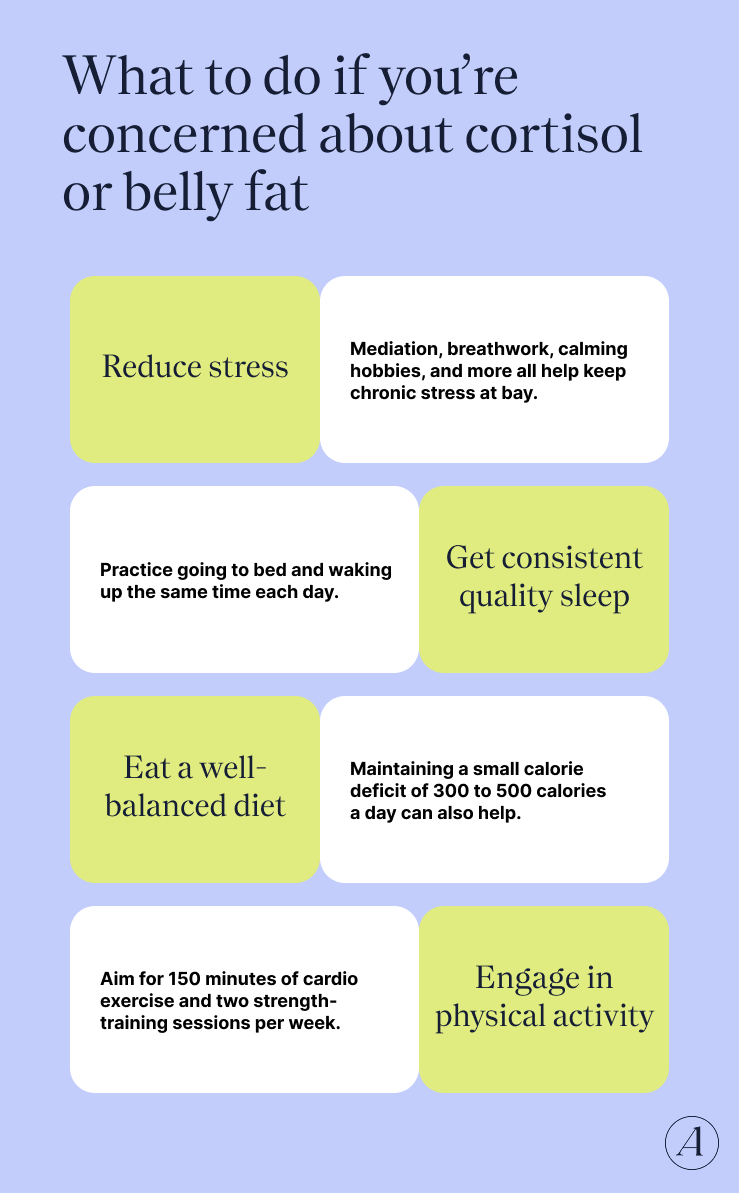
If you’re concerned about cortisol or belly fat, the good news is that the below tactics can help reduce visceral and overall fat in just a few weeks, with further improvements occurring over time.
If you remain concerned about cortisol or suspect an underlying condition, never hesitate to reach out to a knowledgeable and compassionate provider for a weight-neutral conversation. And definitely seek care if you notice symptoms consistent with Cushing’s syndrome, as noted earlier in the article.
A provider can also test your cortisol levels if necessary, assess your overall health, and help provide strategies for addressing your concerns.
You cannot “flush” cortisol out of your body. Cortisol is a necessary hormone that supports your stress response, your immune system, your cardiovascular health, and more. However, sometimes cortisol can become dysregulated. In these cases, you may need to lower your cortisol level under the guidance of a medical professional. But you cannot get rid of cortisol completely.
Although dysregulated cortisol can lead to excess belly fat, you cannot tell by looking in the mirror whether your belly fat is indirectly caused by this stress hormone.
Belly fat is not cortisol itself. Sometimes cortisol can indirectly cause increases in weight around the midsection. However, the only way to know this is to seek an evaluation with a healthcare provider.
“Cortisol belly” is a nonmedical term. It’s internet slang for weight gain around the waistline that wellness influencers attribute to stress. Indeed, stress can contribute to belly fat, but it does so indirectly, and other factors also play a role.
“I was given an explanation of how my hormonal imbalance was affecting me as a whole - body & mind - & tools so that we could start to manage my condition. I am happy to announce after a year of trying, I found out that I was pregnant & I couldn’t be happier!”


“This is genuinely the first time in my 7 years of being diagnosed, that I have felt seen and heard.”

“The Allara Community gives me the courage and support to continue my PCOS journey - I am never afraid to ask the hard questions and love hearing from other women with the same challenges.”

"My doctor went above and beyond making sure I had all the necessary tests, but also tremendously helped me in understanding my diagnosis, helping me change my lifestyle, and making sure I get the treatment I deserve."

"Before Allara I had no real direction or understanding of what it meant to have PCOS. Now I have a team of people that take time to explain every single thing to me, ask me how I feel and let me be a part of my treatment plan."


