

last updated:
February 20, 2026
min read
Signs of thyroid issues: What they look like and when to get checked



Signs of thyroid problems can be tricky to pick up on because when they first start, they may be subtle and overlap with other potential conditions. However, if you have unexplained symptoms that are affecting your quality of life, you may wish to get your thyroid checked with a simple blood test.
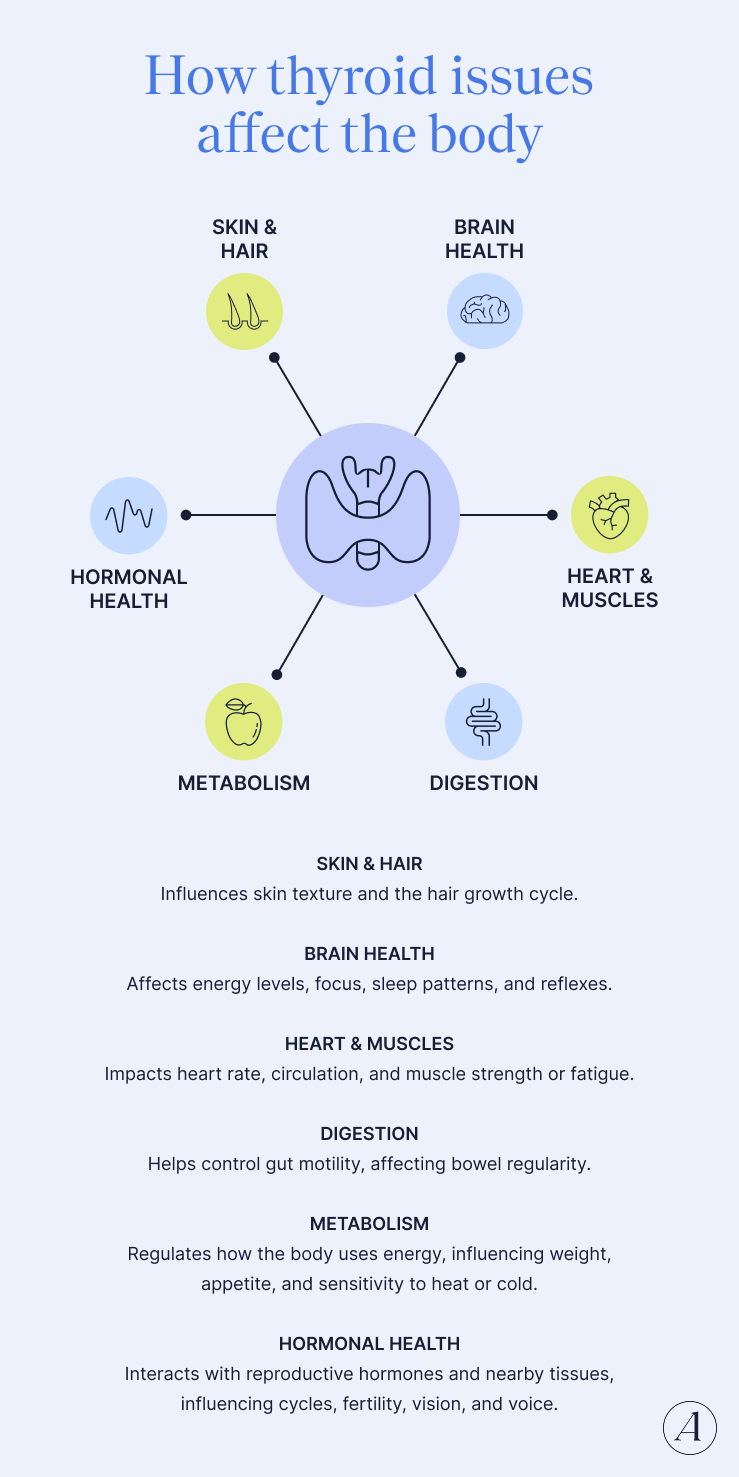
Your thyroid gland is a bit of a workhorse in your body. It helps manage your metabolism, weight, body temperature, and more. When something goes wrong with it, unpleasant symptoms can crop up, including fatigue, weight changes, temperature intolerance, sleep disturbances, brain fog, anxiety, depression, and even skin and hair changes.
As you can see, the thyroid gland, and the hormones it produces and secretes, matters significantly for your overall well-being and health. That’s why if you have unexplained symptoms, the thyroid gland is worth getting checked out to confirm or rule out a thyroid problem.
When your thyroid is underactive, the condition is called hypothyroidism. When it’s overactive, the condition is called hyperthyroidism. Most commonly these conditions occur because of autoimmune issues. In these cases, immune system proteins called antibodies mistakenly attack the thyroid gland. Hashimoto thyroiditis is autoimmune hypothyroidism. And Graves’ disease is autoimmune hyperthyroidism. However, other factors can lead to thyroid concerns.
In this article, we explore thyroid disease symptoms, signs of hypothyroidism, signs of hyperthyroidism, and more.
“The thyroid gland, a small butterfly-shaped organ situated at the base of the neck, is the master regulator of your body’s endocrine system, primarily through the production and release of crucial hormones,” says Sonia Gibson, MD, a board-certified lead endocrinologist at Allara. These hormones include thyroxine (T4) and triiodothyronine (T3).
She adds, “This gland plays a central, indispensable role in your body’s overall metabolic functions. It sets the speed for nearly every cellular process in the body.”
The thyroid’s most crucial functions include the following:
The table below can help you navigate symptoms of hypothyroidism vs. hyperthyroidism and whether they are early signs or indicate a more progressed state.
Here we explore some of the most common thyroid symptoms more in depth.
Extreme chronic fatigue can be a sign of either hypothyroidism or hyperthyroidism. “This is often one of the most prominent symptoms,” Dr. Gibson says. “It is a profound, persistent feeling of tiredness that is not relieved by rest or sleep. This deep, unremitting exhaustion can significantly interfere with professional, social, and personal activities, making even simple tasks feel overwhelmingly difficult.” However, in early hyperthyroidism, you might feel wired or restless instead.
In hypothyroidism, you may experience cold intolerance. “This is a direct consequence of the body’s decreased metabolic rate,” Dr. Gibson says, “which reduces the internal heat generation necessary for maintaining optimal body temperature.” With hyperthyroidism, you might feel heat intolerance or increased sweating because of an increased BMR.
With hypothyroidism, “individuals may experience weight gain, despite no change in diet or exercise routine,” Dr. Gibson says. “This weight gain is often accompanied by puffiness or swelling, particularly around the face, eyelids, hands, and feet, due to fluid retention and a slowed metabolism.” With hyperthyroidism, weight loss can occur despite an increased appetite.
Hypothyroidism typically slows the heart rate, a condition called bradycardia, Dr. Gibson explains, while hyperthyroidism accelerates it, a condition called tachycardia, which may cause palpitations.
Hair and skin changes are also common with thyroid conditions. With hypothyroidism, the skin often becomes noticeably dry, rough, and thickened. “There may be a lack of perspiration, and the skin can feel cool to the touch,” Dr. Gibson says. “In some cases, the skin takes on a pale or yellowish tinge.” Skin changes might be less noticeable with hyperthyroidism, though unexplained hot or flushed skin can be a sign.
Excessive hair shedding or thinning across the scalp and the loss of the outer third of the eyebrows can indicate hypothyroidism. “The hair itself may become dry, brittle, and coarse due to the impact of low thyroid hormone on hair follicle health and the hair-growth cycle,” Dr. Gibson explains. Hair thinning, however, can also be a sign of hyperthyroidism.
Changes in bowel habits can occur with thyroid conditions. Typically, constipation correlates with hypothyroidism, while diarrhea or loose stools correlate with hyperthyroidism. These changes can be subtle at first. With hypothyroidism, you may first notice hard and dry stools, for example.
Thyroid conditions can also affect your mental and cognitive health. Hypothyroidism sometimes leads to brain fog (difficulty focusing, concentrating, or thinking). It can also contribute to depression symptoms. Hyperthyroidism is linked to anxiety, panic, nervousness, and irritability.
Sleep issues are common with thyroid disorders. Reduced sleep quality or insomnia may be an indicator of either hypothyroidism or hyperthyroidism.
Muscle weakness is a symptom of both hypothyroidism and hyperthyroidism. Stiffness or cramping sometimes occurs with hypothyroidism. And muscle loss is common with hyperthyroidism.
Both hypothyroidism and hyperthyroidism can lead to fertility issues and menstrual changes, including irregular periods and even amenorrhea (the absence of periods). With hypothyroidism, you may experience heavier periods, while with hyperthyroidism they may be lighter.
Puffy eyelids or skin around the eyes is common with hypothyroidism, while gritty or dry eyes are common symptoms of hyperthyroidism. Graves’ disease sometimes causes proptosis (bulging eyes).
Your voice can change because of thyroid conditions, with hoarseness a common symptom of hypothyroidism, and goiter (an enlarged thyroid gland) a symptom of hypothyroidism. Goiter symptoms include neck lumps or a sensation of fullness or even difficulty swallowing or breathing in extreme cases.
Your reflexes may be slowed with hypothyroidism, but with hyperthyroidism, you might experience hyperreflexia, where your reflexes are overactive or exaggerated.
If you have unexplained symptoms, especially any of the issues mentioned in the previous section, getting checked out is a good idea. “Although these symptoms are common and non-specific, a simple blood test can rule out a thyroid condition,” Dr. Gibson says.
Additionally, you can ask your regular physician to incorporate routine testing. “Incorporating a basic thyroid-stimulating hormone (TSH) screening into the annual preventive physical examination is often considered best practice,” Dr. Gibson notes. “This routine screening can detect subclinical or early-stage thyroid dysfunction before overt symptoms manifest, allowing for timely intervention.”
Here are a few additional factors to consider that warrant an evaluation with a clinician:
“Thyroid conditions can range from common hypothyroidism and hyperthyroidism to more complex issues like myxedema coma and thyroid storm, which are serious and can indeed be life-threatening if left undiagnosed and untreated,” Dr. Gibson says.
“The good news,” she adds, “is that thyroid disorders are exceptionally well-understood and are typically easy to treat through the use of precise medications (such as synthetic thyroid hormones) or other proven modalities.”
The first step to evaluating your thyroid gland is a blood test to check your levels of thyroid stimulating hormone (THS), a hormone that your pituitary gland secretes.
“This hormone is considered the gold standard initial test because it exhibits a remarkably long, linear, and inverse relationship with the levels of the free thyroid hormones,” Dr. Gibson says. These hormones include free thyroxine (fT4) and free triiodothyronine (fT3).
Although fT4 and fT3 are the hormones that exert the actual biological effect, measuring them initially has some significant limitations. That’s why clinicians measure THS.
“This delicate feedback loop can be conceptualized using the furnace and thermostat analogy,” Dr. Gibson explains.
The “3 p.m. crash in hypothyroidism” isn’t a medical term. It’s a phrase people use to describe heavy fatigue mid-afternoon that can lead to brain fog, which is an inability to concentrate and think.
Thyroid conditions can show up at any age from infancy to your senior years. However, one of the most common times for symptoms to arise is during perimenopause, also called the menopause transition, and beyond.
You can watch for thyroid symptoms to appear, but the only way to check thyroid health is through a blood test analyzed by a clinician.
Yes, thyroid problems can cause mental and cognitive health symptoms. Depression tends to correlate more with hypothyroidism, while anxiety tends to show up more in hyperthyroidism.
“I was given an explanation of how my hormonal imbalance was affecting me as a whole - body & mind - & tools so that we could start to manage my condition. I am happy to announce after a year of trying, I found out that I was pregnant & I couldn’t be happier!”


“This is genuinely the first time in my 7 years of being diagnosed, that I have felt seen and heard.”

“The Allara Community gives me the courage and support to continue my PCOS journey - I am never afraid to ask the hard questions and love hearing from other women with the same challenges.”

"My doctor went above and beyond making sure I had all the necessary tests, but also tremendously helped me in understanding my diagnosis, helping me change my lifestyle, and making sure I get the treatment I deserve."

"Before Allara I had no real direction or understanding of what it meant to have PCOS. Now I have a team of people that take time to explain every single thing to me, ask me how I feel and let me be a part of my treatment plan."


