

last updated:
January 26, 2026
min read
Is it your hormones? How to spot the signs of imbalance




Your hormones are complex, working individually but affecting each other. However, sometimes hormones underperform or overperform, leading to a domino effect with other hormones. When their usual harmony becomes disrupted, whether from the natural course of aging or because of an underlying issue, an imbalance or dysregulation can occur.
As a woman fully in the throes of perimenopause, I often find myself asking, “Is it hot in here or is it my hormones?” Spoiler alert: The answer is usually my hormones. Maybe you’re having hot flashes like me, or experiencing other symptoms, such as irregular periods during your reproductive years or weight changes despite your diet and activity levels remaining the same. If so, you might be asking yourself if you have a hormonal imbalance and how to balance your hormones.
“I like to explain hormones as messengers within the body,” says Maribelle Faucett, WHNP, clinical manager and provider at Allara Health. “These messages are sent by glands (like the ovaries, thyroid, adrenal glands, and pancreas) that travel through the bloodstream to tell organs and tissues what to do and when to do it.”
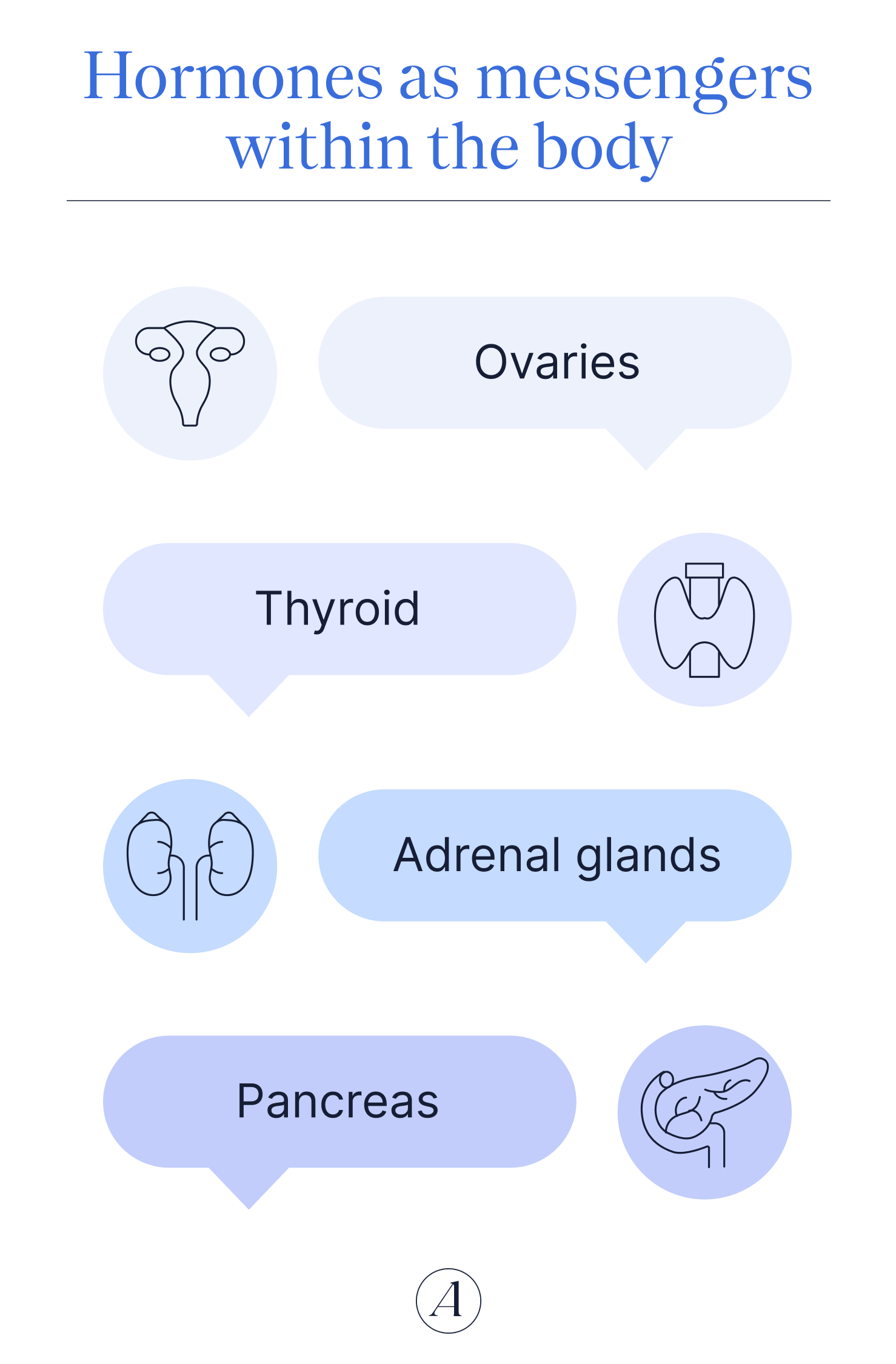
Although each hormone has its specific job functions, your hormones impact each other, as if they were individual employees in one great big organization—your body. Your hormone levels also change, in some cases throughout the day, throughout a month, and over the course of your lifespan.
The words “balance” or “imbalance” are often used to discuss hormones. But they may not be the best word choices. “Homeostasis” might be a better way to think about hormones. This word illustrates how your endocrine system has various feedback loops to keep things in the body operating smoothly and in concert. However, when hormones go a little haywire, symptoms can show up.
In this article, we’ll explore hormonal fluctuations, longer-term hormonal changes, signs of a hormonal imbalance (or dysregulation), hormone imbalance testing, and more.
Hormones are complex. We have a mix of sex or reproductive hormones, hormones that help us manage how we convert food to energy and influence our weight and appetite, hormones that are related to our stress response, and more.
They all interact with each other to a certain extent. So figuring out why you’re experiencing a specific symptom takes a bit of detective work to see how all your hormones are performing together in their beautiful bodily orchestra. Think of this this way: Some may be underperforming while others may be stealing the show.
“Hormones are meant to fluctuate, daily, monthly, among different ages,” Faucett says. “Some hormones even vary throughout the hours of the day. This is normal. However, when they become continuously dysregulated to the degree that an organ or tissue can no longer function for its purpose, it can lead to persistent and disruptive symptoms.”
She provides an example. “If your thyroid is underactive, in the case of hypothyroidism, this can lead to fatigue, weight gain, sensitivity to cold, constipation, and thinning hair,” she says.
The following is a huge alphabetical list of hormonal imbalance symptoms, but just because you have one of these symptoms does not automatically mean one or more your hormones have gone haywire.
Potential symptoms of a hormone imbalance:
The table below should not be used as a diagnostic tool, but it illustrates just how complex hormones are, and showcases which hormone (or hormones) are associated with each symptom.
Key:

Before we explore why hormones can become disrupted, we have to dig into the fact that normal fluctuations also occur that can sometimes cause symptoms either temporarily or longer term.
These natural fluctuations that occur daily, monthly, or over your lifetime aren’t necessarily considered hormone imbalances. However, symptoms can still be unpleasant, and if you’re experiencing bothersome issues, never hesitate to consult a healthcare provider who can help you find solutions tailored to your needs.
Remember that orchestra analogy mentioned above? Well, sometimes one hormone has an outsized performance, overshadowing other hormones. In these cases, you might be experiencing a hormonal imbalance.
“Hormonal dysregulation can happen for many reasons,” Faucette says, “including chronic stress, insulin resistance, inflammation, thyroid dysfunction, nutritional deficiencies, sleep disruption, certain medications, underlying medical conditions, or major life transitions.”
Here, we explore common conditions that cause hormonal disruptions to normal patterns.
Produced in the pancreas, insulin is a hormone that’s key for regulating glucose (blood sugar) levels. However your cells can become resistant to insulin’s signals, a condition called insulin resistance. Insulin resistance can also impact your sex or reproductive hormones, leading to symptoms, including “PCOS face.” Taking steps to keep your body more insulin sensitive can help manage blood sugar levels and reduce your risk for type 2 diabetes.
PCOS impacts the ovaries and adrenal glands in people assigned female at birth. The condition can trigger complications and discomfort. Common symptoms include ovarian cysts, irregular or absent menstrual cycles, increased androgen (e.g., testosterone) levels, acne, hirsutism (unwanted facial or body hair), and more. Insulin resistance is often a key characteristic, so PCOS is an example of a condition with multiple hormonal concerns at play.
Thyroid hormone is a group of hormones your thyroid gland produces. These include thyroxine (T4) and triiodothyronine (T3). When the gland is overactive (hyperthyroidism), it produces too much thyroid hormones. When it’s underactive (hypothyroidism), it does not produce enough. Your sex/reproductive hormones also interact with your thyroid hormones, so thyroid disorders can also lead to multiple hormonal issues.
This midlife change for people assigned female at birth is not a condition, but it does lead to significant hormonal changes and sometimes corresponding symptoms. Menopause is a moment in time when you’ve had an absence of a period for a full year, after that you’re in postmenopause. Perimenopause is when the hormonal changes leading up to menopause and beyond occur. At first, your sex hormones might fluctuate erratically before eventually declining around the time of menopause.
Cortisol is your “stress hormone.” It’s a crucial part of a healthy stress response. However, you can develop chronic stress, where your natural cortisol patterns become dysregulated. This can then impact insulin, sex hormones, and more, leading to an imbalance of multiple chemical messengers.
This condition involves abnormally high levels of prolactin, a hormone that stimulates breast development and lactation (milk production) in birthing parents. Sometimes pituitary gland tumors can lead to this condition. But thyroid disorders, certain medications, and other hormonal disruptions can mimic the symptoms of too much prolactin.
A knowledgeable clinician can serve as your trusted hormone detective, helping to determine if your symptoms are related to your hormones and which ones. Remember, your hormones affect each other, so you could be dealing with a domino cascade.
The good news is that once a clinician pinpoints what’s potentially going on, they can offer you solutions to help you feel better.
“Clinicians use a combination of clinical history, symptoms, and lab testing,” Faucette explains. “Blood tests are most common and may include reproductive hormones, thyroid markers, insulin and glucose levels, and inflammatory markers.”
The short answer is to talk to a clinician who can investigate your body’s clues.
“I am a huge advocate for early evaluation,” Faucette says. “If you have that thought in the back of your mind that ‘something doesn’t seem right,’ whether you have persistent symptoms, signs you see are worsening, especially if affecting your life, don’t wait—get checked.”
You might even wish to have your hormones evaluated when you’re feeling generally good or without symptoms. You don’t need a smattering of symptoms to be curious or get a baseline picture.
“Often, as clinicians, we can sometimes see signs that something might evolve over time, and baseline labs can also be very helpful to trend this,” Faucette says. “Not only that, but we don’t want you to wait until you feel so bad that it will seem like a strenuous uphill battle to get you feeling better. We want to work with you before it gets to that point.”
Need somewhere to turn? “Allara provides comprehensive, focused care for hormonal conditions,” Faucett says. “From the comfort of your home, we can get you set up for labs and care.”
You have the support of a medical provider and a registered dietitian to guide you through lifestyle changes, supplement recommendations or medications if needed, and more.
“We have so many things to worry about nowadays,” Faucett adds, “I love that we help navigate health to get you feeling better so you can tackle life with one less thing to feel is holding you back.”
A hormone imbalance may be the culprit if you notice menstrual cycle irregularities, fertility issues, unexplained symptoms that are affecting your quality of life, and more. If this is the case, reach out to a knowledgeable healthcare provider who can investigate and provide solutions.
To fix a hormone imbalance, you first have to figure out if your hormones have become dysregulated and which ones are affected. Sometimes lifestyle changes, supplements, or medications may be needed, but your treatment plan will depend on factors unique to you.
Yes, a hormonal imbalance, or even just normal fluctuations, can lead to sweating. For example, vasomotor symptoms (hot flashes and night sweats) might show up for you during the menopause transition. But you might even notice these issues in your reproductive years, especially in the days leading up to your period.
“I was given an explanation of how my hormonal imbalance was affecting me as a whole - body & mind - & tools so that we could start to manage my condition. I am happy to announce after a year of trying, I found out that I was pregnant & I couldn’t be happier!”


“This is genuinely the first time in my 7 years of being diagnosed, that I have felt seen and heard.”

“The Allara Community gives me the courage and support to continue my PCOS journey - I am never afraid to ask the hard questions and love hearing from other women with the same challenges.”

"My doctor went above and beyond making sure I had all the necessary tests, but also tremendously helped me in understanding my diagnosis, helping me change my lifestyle, and making sure I get the treatment I deserve."

"Before Allara I had no real direction or understanding of what it meant to have PCOS. Now I have a team of people that take time to explain every single thing to me, ask me how I feel and let me be a part of my treatment plan."


